Thermo-Optic Phase Shifters
A thermo-optic phase shifter heats a waveguide to change its phase. P_π, thermal time constant, crosstalk, trenches, TiN vs doped-silicon heaters.
Research
Integrated photonic components on silicon and group-IV platforms — ring resonators, waveguide devices, and Ge-on-Si photodetectors — designed through simulation.
Photonic integrated circuits bring many optical functions onto a single chip. My work spans integrated ring-resonator devices, silicon-compatible Ge photodiodes and Si/Ge heterostructures, and plasmonic structures in highly doped GeSn on silicon.
On the computational side, I maintain an open-source photonics simulation toolkit that builds and validates PIC components with Meep FDTD and GDSFactory layouts, then composes them into circuit-level models.
Science Advances 10(15), eadn60952024
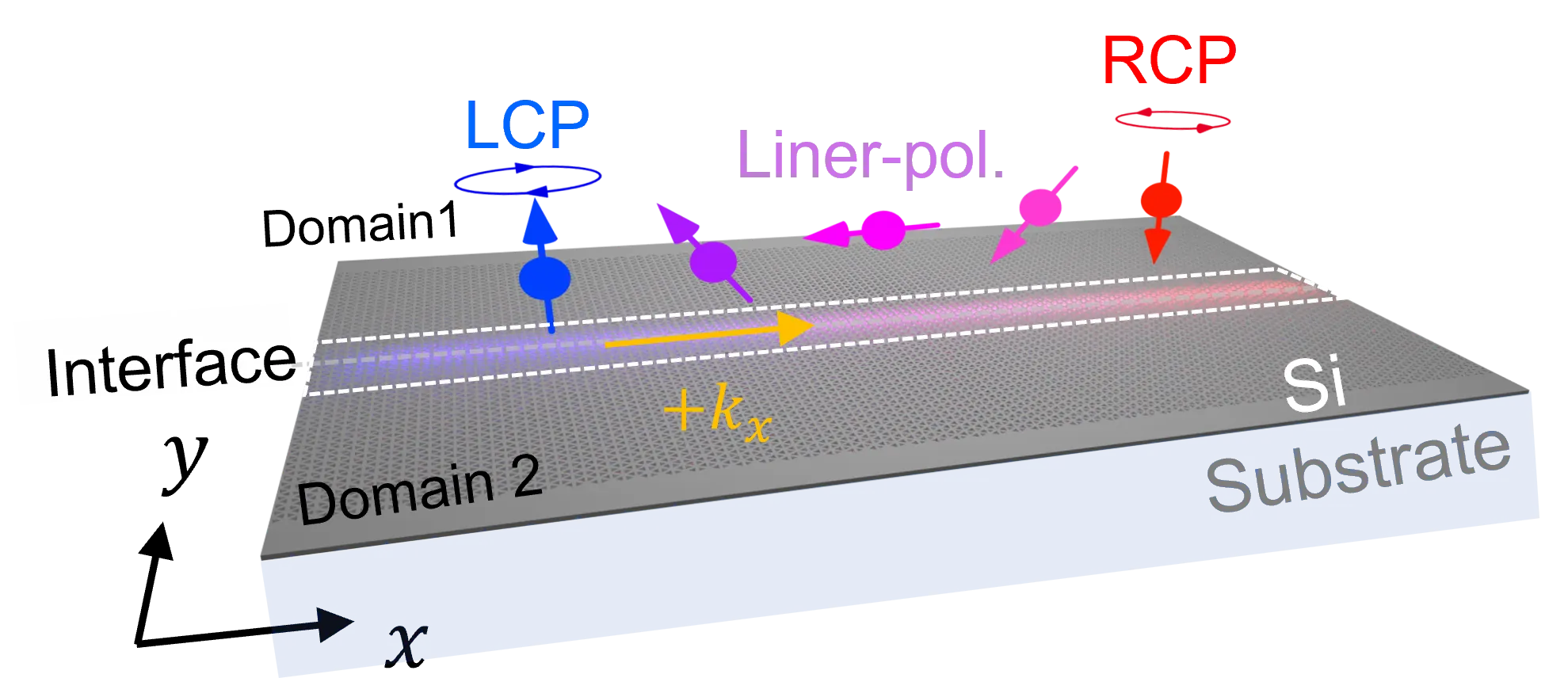
Topological boundary modes in electronic and classical-wave systems exhibit fascinating properties. In photonics, topological nature of boundary modes can make them robust and endows them with an additional internal structure—pseudo-spins. Here, we introduce heterogeneous boundary modes, which are based on mixing two of the most widely used topological photonics platforms—the pseudo-spin–Hall-like and valley-Hall photonic topological insulators. We predict and confirm experimentally that transformation between the two, realized by altering the lattice geometry, enables a continuum of boundary states carrying both pseudo-spin and valley degrees of freedom (DoFs). When applied adiabatically, this leads to conversion between pseudo-spin and valley polarization. We show that such evolution gives rise to a geometrical phase associated with the synthetic gauge fields, which is confirmed via an Aharonov-Bohm type experiment on a silicon chip. Our results unveil a versatile approach to manipulating properties of topological photonic states and envision topological photonics as a powerful platform for devices based on synthetic DoFs.
Applied Physics Letters 122(12), 1217012023
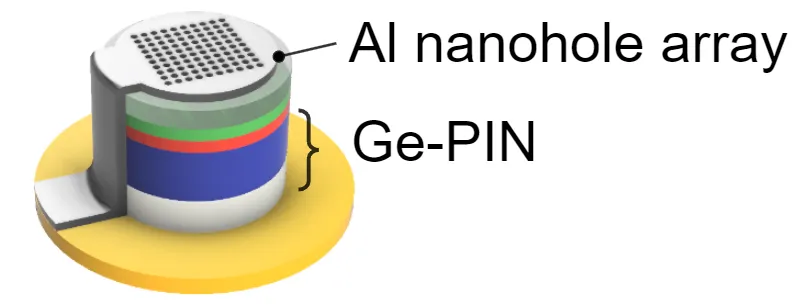
We present a design for silicon-compatible vertical Germanium pin photodiodes structured into all-dielectric metasurfaces. Proof-of-principle metasurfaces are fabricated on silicon-on-insulator wafers in a top-down process. Simulations and measurements of the spectroscopic properties, specifically the absorption, show high spectral selectivity, and absorption efficiencies as large as those in bulk Germanium layers with about four times the Ge layer thicknesses. Our metasurface structures can be tuned to the target wavelength through tailoring of the lateral geometry. Possible applications include spectroscopy and hyperspectral imaging, with several metasurfaces for different wavelength ranges integrated with readout circuitry into a low-cost electronic–photonic integrated circuit.
Optical Materials Express 12(4), 14532022
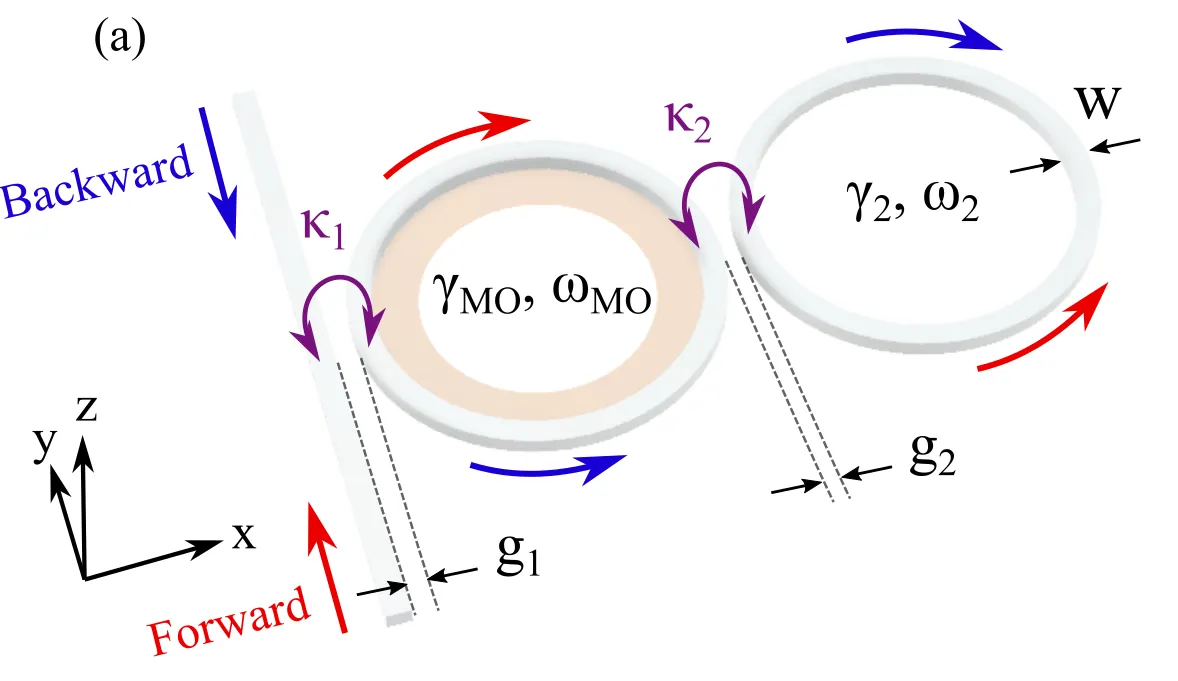
In this paper, we explore the operation of a nonreciprocal non-Hermitian system consisting of a lossy magneto-optical ring resonator coupled to another ring resonator with gain and loss, and we demonstrate that such a system can exhibit non-reciprocity-based broken parity-time (PT) symmetry and supports one-way exceptional points. The nonreciprocal PT-phase transition is analyzed with the use of both analytical tools based on coupled-mode theory and two-dimensional finite element method simulations. Our calculations show that the response of the system strongly depends on the regime of operation – broken or preserved PT-symmetry. This response is leveraged to show that the system can operate as an optical isolator or a one-way laser with functionality tuned by adjusting loss/gain in the second ring resonator. The proposed system can thus be promising for device applications such as magnetically or even optically switchable non-reciprocal devices and one-way micro-ring lasers.
Journal of Physics D: Applied Physics 54(44), 4451092021
Plasmonic modes in metal structures are of great interest for optical applications. While metals such as Au and Ag are highly suitable for such applications at visible wavelengths, their high Drude losses limit their usefulness at mid-infrared wavelengths. Highly n-doped Ge1−y Sn y alloys are interesting possible alternative materials for plasmonic applications in this wavelength range. Here, we investigate the use of highly n-doped Ge1−y Sn y films grown directly on Si by molecular beam epitaxy with varying Sn-content from 0% up to 7.6% for plasmonic grating structures. We compare plasma wavelengths and relaxation times obtained from electrical and optical characterization. While theoretical considerations indicate that the decreasing effective mass with increasing Sn content in Ge1−y Sn y films could improve performance for plasmonic applications, our optical characterization results show that the utilization of Ge1−y Sn y films grown directly on Si is only beneficial if material quality can be improved.
Applied Physics Letters 118(24), 2411042021
Nonreciprocal optical devices based on magneto-optical ferrites in their low-loss regimes have been widely investigated as a promising platform for integrated photonics. Nonreciprocity in such devices originates from circular birefringence, leading to frequency splitting of forward and backward modes and, as a result, nonreciprocal transmission. In this paper, we propose an alternative approach to realize nonreciprocal devices based on magneto-optical circular dichroism and relying on the very presence of optical absorption. Our approach relies on the phenomenon of spin-Hall effect of light, which gives rise to chiral near field interactions of light carrying transverse angular momentum with matter, which, in lossy regimes, yields a disparate absorption for forward and backward optical modes. As an example of practical application, we design an optical isolator based on ring resonator integrating Ce:YIG ferrite, and we demonstrate isolation near 880 nm absorption line due to the ionic electric dipole transition. A Ce:YIG film asymmetrically placed on the inner side of the ring yields different critical coupling conditions due to the chiral nature of evanescent light for forward and backward waves, leading to nonreciprocal absorption and transmission. The proposed approach to nonreciprocity may significantly broaden the possible choice of magneto-optical materials for nonreciprocal devices, enabling operation even in lossy regimes.
ACS Photonics 5(11), 4586-45932018
A thermo-optic phase shifter heats a waveguide to change its phase. P_π, thermal time constant, crosstalk, trenches, TiN vs doped-silicon heaters.
The Purcell effect is the change of an emitter's spontaneous emission rate by its optical environment. Q, mode volume, L3 and nanobeam cavity design.
A topological photonic crystal guides light along domain walls set by band topology. Berry phase, Chern number, spin-Hall and valley-Hall crystals, and design.
A WDM demultiplexer sends each wavelength channel to its own waveguide. How cascaded Mach–Zehnder lattice filters set channel spacing, passband and crosstalk.
A Mach–Zehnder modulator turns a drive voltage into an arm phase difference and then into light intensity. Pockels effect, voltage–length product, bandwidth.
A silicon waveguide confines light in a high-index core by total internal reflection. How width, thickness and wavelength set its modes and indices.
FDTD, FEM and RCWA are the main methods for solving Maxwell's equations in photonics. How each works, what it costs, and which problems each one suits.
Topology optimization, gradient-based optimizers and the adjoint method are the three parts of photonic inverse design. What each does and how they fit together.
Directional couplers, MZIs and ring resonators are one coupler matrix used three ways. How that sets their spectra, sensitivity and how circuits are built.
A directional coupler moves light between two nearby waveguides by evanescent coupling. How gap, length and wavelength set its split ratio, in theory and FDTD.
A grating coupler diffracts light from a chip waveguide into an optical fiber. How period, etch, BOX and apodization set its efficiency, checked with FDTD.
A Mach–Zehnder interferometer splits and recombines light so that the arm phase difference picks the output. Transfer function, FSR, extinction, switching.
A ring resonator is a waveguide loop beside a bus that removes or drops light at resonant wavelengths. Resonance, Q, critical coupling and how to design them.