Topological Photonic Crystals
A topological photonic crystal guides light along domain walls set by band topology. Berry phase, Chern number, spin-Hall and valley-Hall crystals, and design.
Research
Photonic topological insulators, boundary modes with pseudo-spin and valley degrees of freedom, and topologically protected resonators.
Topological photonics borrows ideas from condensed-matter physics to build optical structures whose key properties are protected by global, topological features of the band structure. This makes it possible to guide light along boundaries in ways that are robust to certain defects, and to give light additional synthetic degrees of freedom — pseudo-spin and valley.
My research includes heterogeneous topological boundary modes that convert between pseudo-spin and valley polarization (with an Aharonov–Bohm-type demonstration on a silicon chip), spin-dependent guided modes in photonic Dirac metasurfaces, topological polaritonic structures in transition-metal-dichalcogenide crystals, and freeform topological vortex resonators with spectrally stable modes.
Physical Review B 114(5), 0554172026
Topological phases and modes, including the pseudospin Hall effect with robust edge transport and higher-order corner states, provide versatile control of wave propagation and modal confinement in classical wave platforms. Motivated by the need to systematically engineer multigap interface and corner localization with enhanced design freedom in kagome-derived lattices, we theoretically investigate two types of extended kagome lattices within a tight-binding framework. These lattices support a series of localized modes, including pseudospin Hall interface states and corner states in multiple band gaps and at different frequencies. Meanwhile, the extended kagome designs introduce additional tunable structural parameters, offering enhanced flexibility for tailoring topological and localized states. By constructing two types of extended kagome lattices with distinct topological properties, we identify multiple groups of corner states, pseudospin Hall effect achieved by band folding or accidental degeneracy, and type-II corner states without long-range interactions. These results highlight extended kagome lattices as a flexible platform for topological waveguiding and multifrequency corner-state localization.
arXiv preprint2026Preprint
Topological concepts have been at the forefront of materials research in recent years, driving a revolution in our understanding of the response of quantum materials and enabling new ways to manipulate light and sound in topological metamaterials. Topological defects and topological boundaries of different dimensions have driven a paradigm shift in photonics, where topological photonic crystals and metamaterials can be engineered to create one-way flow of energy robust to defects or to control such flows with synthetic degrees of freedom along topological domain walls. More recently, topological point singularities encoded into photonic structures have been shown to enable confinement of optical modes with the topologically nontrivial nature of the cavity imprinted into the vorticity of optical far fields. Here we demonstrate that the two latter concepts - domain wall and point singularities - can be unified into an even more powerful tool to enable arbitrarily shaped resonant cavities of any dimension supporting spectrally stable zero-energy modes. We experimentally confirm that such modes, whose existence is guaranteed by topological principles, allow an unprecedented degree of control over the optical field, which appears to have no phase modulation across space, can have any desirable radiation pattern, and enables spectral stability regardless of shape or length.
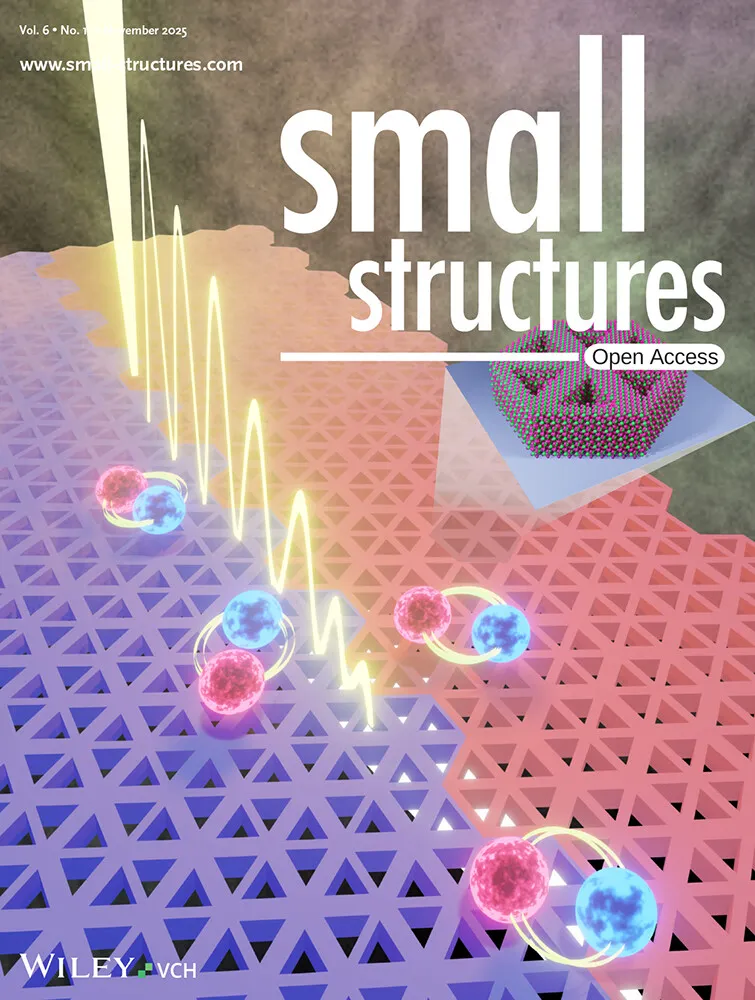
Small Structures 6(11), 701422025
Science Advances 10(15), eadn60952024
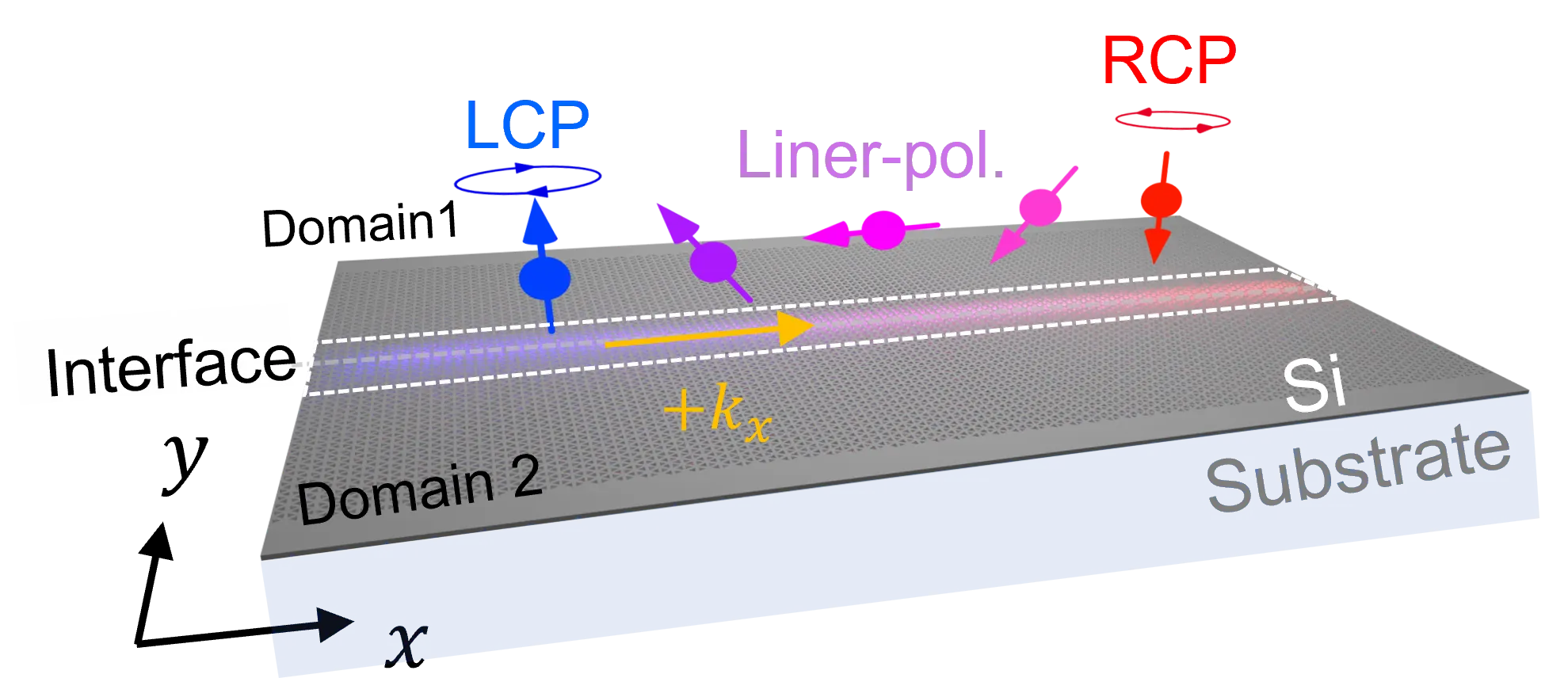
Topological boundary modes in electronic and classical-wave systems exhibit fascinating properties. In photonics, topological nature of boundary modes can make them robust and endows them with an additional internal structure—pseudo-spins. Here, we introduce heterogeneous boundary modes, which are based on mixing two of the most widely used topological photonics platforms—the pseudo-spin–Hall-like and valley-Hall photonic topological insulators. We predict and confirm experimentally that transformation between the two, realized by altering the lattice geometry, enables a continuum of boundary states carrying both pseudo-spin and valley degrees of freedom (DoFs). When applied adiabatically, this leads to conversion between pseudo-spin and valley polarization. We show that such evolution gives rise to a geometrical phase associated with the synthetic gauge fields, which is confirmed via an Aharonov-Bohm type experiment on a silicon chip. Our results unveil a versatile approach to manipulating properties of topological photonic states and envision topological photonics as a powerful platform for devices based on synthetic DoFs.
Ph.D. dissertation, The City College of New York, CUNY2024Thesis
Active Photonic Platforms (APP) 2023, Proc. SPIE, 842023Conference paper
Nature Nanotechnology 18(8), 875-8812023
A topological photonic crystal guides light along domain walls set by band topology. Berry phase, Chern number, spin-Hall and valley-Hall crystals, and design.