Research
Nonreciprocal Photonics
Breaking optical reciprocity with magneto-optical, non-Hermitian, and all-optical (valley-selective) mechanisms for isolators and one-way devices.
Nonreciprocal devices such as isolators and circulators enforce one-way flow of light and are essential in photonic systems, yet they are difficult to miniaturize and integrate. My doctoral research explored several routes to on-chip nonreciprocity: ring resonators integrating dichroic magneto-optical materials, non-Hermitian (parity-time symmetric) double-ring systems, and all-optical nonreciprocity from valley polarization in monolayer transition-metal dichalcogenides.
Research questions
- Can on-chip isolation be achieved with compact, integrable magneto-optical or dichroic materials?
- How do parity-time symmetry and gain/loss interact with magneto-optical nonreciprocity in coupled resonators?
- Can valley-selective responses in 2D materials provide magnet-free, all-optical nonreciprocity?
Publications
View filtered archive →Ring Resonators Integrating With Dichroic Materials and in Spin-Valley Controlled Photonic Topological System
Ph.D. dissertation, The City College of New York, CUNY2024Thesis
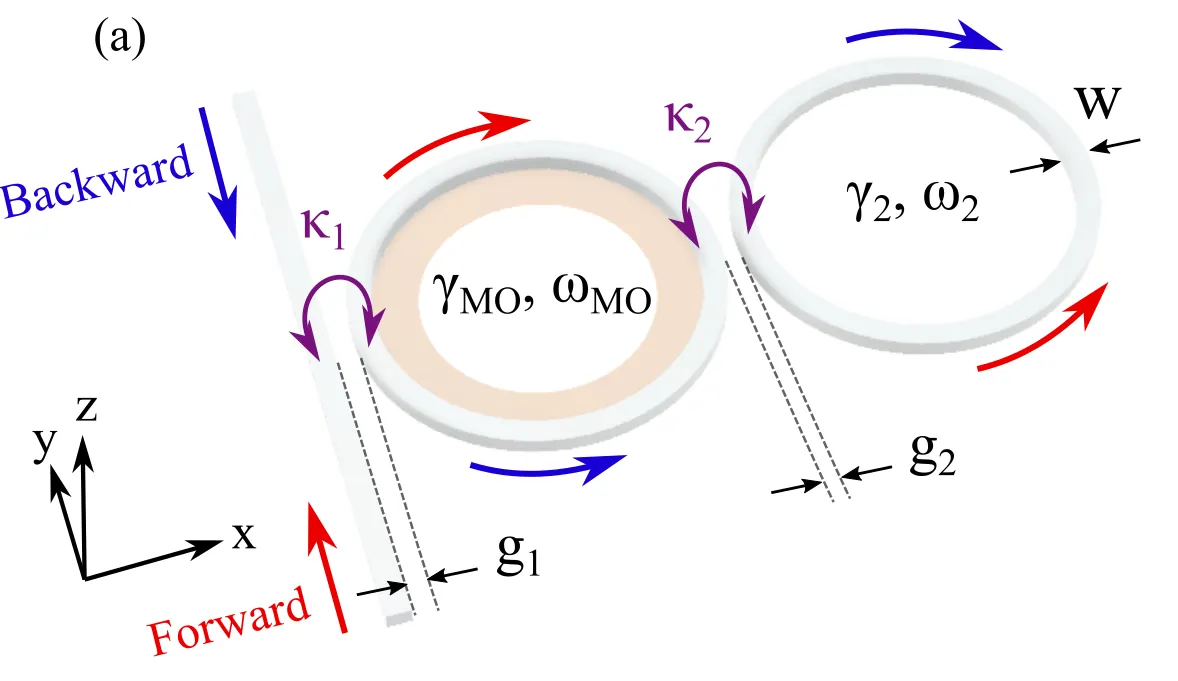
Non-reciprocal parity-time symmetry breaking based on magneto-optical and gain/loss double ring resonators
Optical Materials Express 12(4), 14532022
- DOI
Abstract
In this paper, we explore the operation of a nonreciprocal non-Hermitian system consisting of a lossy magneto-optical ring resonator coupled to another ring resonator with gain and loss, and we demonstrate that such a system can exhibit non-reciprocity-based broken parity-time (PT) symmetry and supports one-way exceptional points. The nonreciprocal PT-phase transition is analyzed with the use of both analytical tools based on coupled-mode theory and two-dimensional finite element method simulations. Our calculations show that the response of the system strongly depends on the regime of operation – broken or preserved PT-symmetry. This response is leveraged to show that the system can operate as an optical isolator or a one-way laser with functionality tuned by adjusting loss/gain in the second ring resonator. The proposed system can thus be promising for device applications such as magnetically or even optically switchable non-reciprocal devices and one-way micro-ring lasers.
All-optical nonreciprocity due to valley polarization pumping in transition metal dichalcogenides
Nature Communications 12(1), 37462021
- DOI
Abstract
Nonreciprocity and nonreciprocal optical devices play a vital role in modern photonic technologies by enforcing one-way propagation of light. Here, we demonstrate an all-optical approach to nonreciprocity based on valley-selective response in transition metal dichalcogenides (TMDs). This approach overcomes the limitations of magnetic materials and it does not require an external magnetic field. We provide experimental evidence of photoinduced nonreciprocity in a monolayer WS2 pumped by circularly polarized (CP) light. Nonreciprocity stems from valley-selective exciton population, giving rise to nonlinear circular dichroism controlled by CP pump fields. Our experimental results reveal a significant effect even at room temperature, despite considerable intervalley-scattering, showing promising potential for practical applications in magnetic-free nonreciprocal platforms. As an example, here we propose a device scheme to realize an optical isolator based on a pass-through silicon nitride (SiN) ring resonator integrating the optically biased TMD monolayer.
Optical isolator based on chiral light-matter interactions in a ring resonator integrating a dichroic magneto-optical material
Applied Physics Letters 118(24), 2411042021
- DOI
Abstract
Nonreciprocal optical devices based on magneto-optical ferrites in their low-loss regimes have been widely investigated as a promising platform for integrated photonics. Nonreciprocity in such devices originates from circular birefringence, leading to frequency splitting of forward and backward modes and, as a result, nonreciprocal transmission. In this paper, we propose an alternative approach to realize nonreciprocal devices based on magneto-optical circular dichroism and relying on the very presence of optical absorption. Our approach relies on the phenomenon of spin-Hall effect of light, which gives rise to chiral near field interactions of light carrying transverse angular momentum with matter, which, in lossy regimes, yields a disparate absorption for forward and backward optical modes. As an example of practical application, we design an optical isolator based on ring resonator integrating Ce:YIG ferrite, and we demonstrate isolation near 880 nm absorption line due to the ionic electric dipole transition. A Ce:YIG film asymmetrically placed on the inner side of the ring yields different critical coupling conditions due to the chiral nature of evanescent light for forward and backward waves, leading to nonreciprocal absorption and transmission. The proposed approach to nonreciprocity may significantly broaden the possible choice of magneto-optical materials for nonreciprocal devices, enabling operation even in lossy regimes.
All-optical nonreciprocity due to valley polarization in transition metal dichalcogenides
arXiv preprint2020Preprint
- arXiv
Abstract
Nonreciprocity and nonreciprocal optical devices play a vital role in modern photonic technologies by enforcing one-way propagation of light. Most nonreciprocal devices today are made from a special class of low-loss ferrites that exhibit a magneto-optical response in the presence of an external static magnetic field. While breaking transmission symmetry, ferrites fail to satisfy the need for miniaturization of photonic circuitry due to weak character of nonreciprocal responses at optical wavelengths and are not easy to integrate into on-chip photonic systems. These challenges led to the emergence of magnetic-free approaches relying on breaking time reversal symmetry, e.g. with nonlinear effects modulating optical system in time. Here, we demonstrate an all-optical approach to nonreciprocity based on nonlinear valley-selective response in transition metal dichalcogenides (TMDs). This approach overcomes the limitations of magnetic materials and it does not require an external magnetic field. We provide experimental evidence of photoinduced nonreciprocity in a monolayer WS2 pumped by circularly polarized light. Nonreciprocity stems from valley-selective exciton-exciton interactions, giving rise to nonlinear circular dichroism controlled by circularly polarized pump fields. Our experimental results reveal a significant effect even at room temperature, despite considerable intervalley-scattering, showing potential for practical applications in magnetic-free nonreciprocal platforms. As an example, we propose a device scheme to realize an optical isolator based on a pass-through silicon nitride (SiN) ring resonator integrating the optically biased TMD monolayer.