Research
Optical Sensing
Integrated refractive-index sensors combining plasmonic nanostructures with Ge photodiodes, and optical ranging with flat optics.
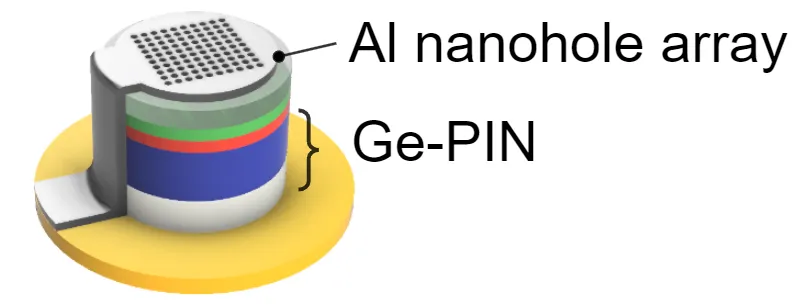
Integrating the sensing element directly with the detector removes bulky optics and makes compact sensors possible. My early work developed integrated refractive-index sensors in which aluminum nanohole arrays are placed directly on Ge PIN photodiodes, with simulation-driven optimization of the sensor geometry. More recent work extends optical sensing to metalens-based ranging.
Research questions
- How can a plasmonic sensing element and a photodetector be integrated collinearly into one compact device?
- What design choices let integrated sensors work with low-cost, broadband sources such as LEDs?
Publications
View filtered archive →Extending the Measurement Capability of a Stereo Metalens Rangefinder Using the Wavelength Dependence of Focal Length
CLEO: Fundamental Science 2026, FW1F.82026Conference paper
- DOI
Abstract
We achieved 1.49 times measurement range expansion of stereo-camera rangefinder by using wavelength-dependent dual-focal-length metalenses working at 740 and 940 nm. Binocular arrangement on a single image sensor enables ultracompact camera system of 1.45 mm 3 .
Optimization of Fully Integrated Al Nanohole Array-Based Refractive Index Sensors for Use With a LED Light Source
IEEE Photonics Journal 14(3), 1-82022
Integrated Collinear Refractive Index Sensor with Ge PIN Photodiodes
ACS Photonics 5(11), 4586-45932018
Simulation-based optimization of Ge-PIN-photodiodes with Al nanohole arrays for refractive index sensing
2018 41st International Convention on Information and Communication Technology, Electronics and Microelectronics (MIPRO), 23–262018Conference paper