Research
Metasurfaces
Engineering light–matter interaction with subwavelength resonator arrays, from magneto-optical enhancement to topological metasurfaces.
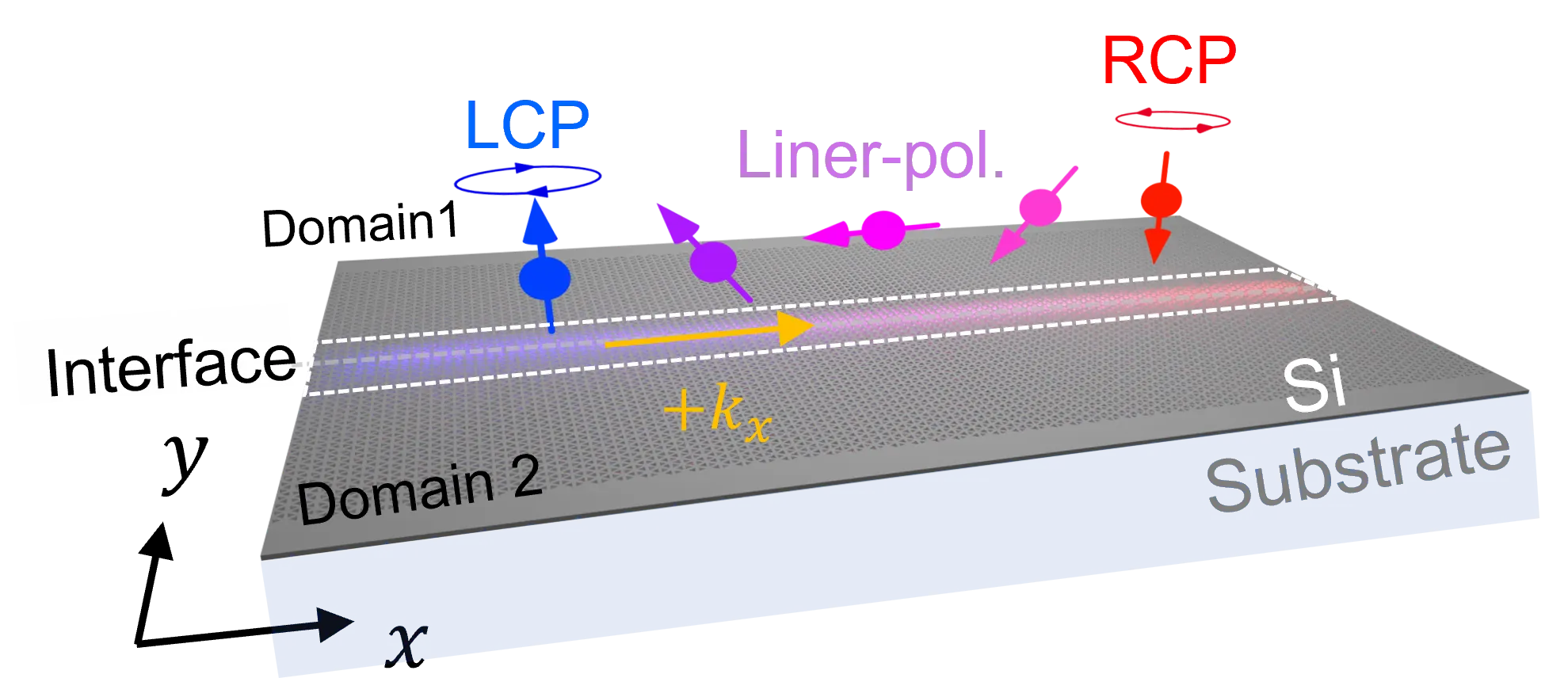
Metasurfaces are planar arrays of subwavelength scatterers whose collective response can be engineered far beyond what a bulk material offers. My work uses them in two ways: as resonant enhancers of weak optical effects (for example, electromagnetically induced transparency boosting Faraday rotation in all-dielectric magneto-optical metasurfaces), and as lattices whose band structure is designed to support topological and spin-dependent guided modes.
A recurring theme is the link between design and fabrication: structures are modeled with full-wave simulation (FDTD, RCWA, FEM) before being realized in silicon and group-IV material platforms, including Si/Ge heterostructure metasurfaces for wavelength-selective photodetection.
Research questions
- How can resonant, all-dielectric metasurfaces enhance weak optical effects such as magneto-optical Faraday rotation?
- How can metasurface lattices be designed to host guided and topological modes with controllable spin and valley properties?
- How can metasurfaces be monolithically combined with semiconductor devices such as photodetectors?
Publications
View filtered archive →Millimeter-Scale Single-Layer RGB Achromatic Metalens via Time-Simultaneity-Free Design
Laser & Photonics Reviews, e721742026
- DOI
Abstract
Compact and high-performance optical components are essential for miniaturizing next-generation imaging and display systems. While metalenses offer a promising ultrathin alternative to refractive optics, scaling up achromatic metalenses is fundamentally hindered by the trade-off between aperture size and operational bandwidth. In this study, we propose a time-simultaneity-free (TSF) approach that strategically abandons temporal simultaneity. By introducing wavelength-dependent DC phase biases into the target phase profiles, we reframe the design as a global phase-space alignment problem, enabling simultaneous phase matching across the red, green, and blue (RGB) wavelengths. Crucially, our theoretical scaling analysis reveals that the multi-wavelength phase efficiency asymptotically converges to a stable lower bound in the large-aperture regime, indicating the potential for macroscopic scalability. Based on this mechanism, we experimentally demonstrate a single-layer, polarization-insensitive silicon nitride metalens with a diameter of 1 mm and a numerical aperture of 0.1. The fabricated device achieves near-diffraction-limited focusing with Strehl ratios of 0.80, 0.97, and 0.95 at 450, 532, and 633 nm, respectively, while tightly bounding focal-length deviations. Furthermore, high-fidelity, full-color imaging of test targets and graphics is successfully demonstrated using a commercial CMOS image sensor. These results provide a highly scalable, application-driven paradigm for macroscopic multi-wavelength metasurface optics.
Freeform Spectrally Stable Topological Photonic Vortex Resonators
arXiv preprint2026Preprint
- arXiv
Abstract
Topological concepts have been at the forefront of materials research in recent years, driving a revolution in our understanding of the response of quantum materials and enabling new ways to manipulate light and sound in topological metamaterials. Topological defects and topological boundaries of different dimensions have driven a paradigm shift in photonics, where topological photonic crystals and metamaterials can be engineered to create one-way flow of energy robust to defects or to control such flows with synthetic degrees of freedom along topological domain walls. More recently, topological point singularities encoded into photonic structures have been shown to enable confinement of optical modes with the topologically nontrivial nature of the cavity imprinted into the vorticity of optical far fields. Here we demonstrate that the two latter concepts - domain wall and point singularities - can be unified into an even more powerful tool to enable arbitrarily shaped resonant cavities of any dimension supporting spectrally stable zero-energy modes. We experimentally confirm that such modes, whose existence is guaranteed by topological principles, allow an unprecedented degree of control over the optical field, which appears to have no phase modulation across space, can have any desirable radiation pattern, and enables spectral stability regardless of shape or length.
Pseudo-spin switches and Aharonov-Bohm effect for topological boundary modes
Science Advances 10(15), eadn60952024
- DOI
Abstract
Topological boundary modes in electronic and classical-wave systems exhibit fascinating properties. In photonics, topological nature of boundary modes can make them robust and endows them with an additional internal structure—pseudo-spins. Here, we introduce heterogeneous boundary modes, which are based on mixing two of the most widely used topological photonics platforms—the pseudo-spin–Hall-like and valley-Hall photonic topological insulators. We predict and confirm experimentally that transformation between the two, realized by altering the lattice geometry, enables a continuum of boundary states carrying both pseudo-spin and valley degrees of freedom (DoFs). When applied adiabatically, this leads to conversion between pseudo-spin and valley polarization. We show that such evolution gives rise to a geometrical phase associated with the synthetic gauge fields, which is confirmed via an Aharonov-Bohm type experiment on a silicon chip. Our results unveil a versatile approach to manipulating properties of topological photonic states and envision topological photonics as a powerful platform for devices based on synthetic DoFs.
Spin-dependent properties of optical modes guided by adiabatic trapping potentials in photonic Dirac metasurfaces
Nature Nanotechnology 18(8), 875-8812023
Robust Si/Ge heterostructure metasurfaces as building blocks for wavelength-selective photodetectors
Applied Physics Letters 122(12), 1217012023
- DOI
Abstract
We present a design for silicon-compatible vertical Germanium pin photodiodes structured into all-dielectric metasurfaces. Proof-of-principle metasurfaces are fabricated on silicon-on-insulator wafers in a top-down process. Simulations and measurements of the spectroscopic properties, specifically the absorption, show high spectral selectivity, and absorption efficiencies as large as those in bulk Germanium layers with about four times the Ge layer thicknesses. Our metasurface structures can be tuned to the target wavelength through tailoring of the lateral geometry. Possible applications include spectroscopy and hyperspectral imaging, with several metasurfaces for different wavelength ranges integrated with readout circuitry into a low-cost electronic–photonic integrated circuit.