Archive
Publications
Complete list of journal articles, conference papers, preprints, and thesis, newest first.
20 publications · 13 journal articles · 4 conference papers · 2 preprints · 1 thesis · 7 first-author
Citation metrics: Google Scholar profile.
2026
Millimeter-Scale Single-Layer RGB Achromatic Metalens via Time-Simultaneity-Free Design
Laser & Photonics Reviews, e721742026
- DOI
Abstract
Compact and high-performance optical components are essential for miniaturizing next-generation imaging and display systems. While metalenses offer a promising ultrathin alternative to refractive optics, scaling up achromatic metalenses is fundamentally hindered by the trade-off between aperture size and operational bandwidth. In this study, we propose a time-simultaneity-free (TSF) approach that strategically abandons temporal simultaneity. By introducing wavelength-dependent DC phase biases into the target phase profiles, we reframe the design as a global phase-space alignment problem, enabling simultaneous phase matching across the red, green, and blue (RGB) wavelengths. Crucially, our theoretical scaling analysis reveals that the multi-wavelength phase efficiency asymptotically converges to a stable lower bound in the large-aperture regime, indicating the potential for macroscopic scalability. Based on this mechanism, we experimentally demonstrate a single-layer, polarization-insensitive silicon nitride metalens with a diameter of 1 mm and a numerical aperture of 0.1. The fabricated device achieves near-diffraction-limited focusing with Strehl ratios of 0.80, 0.97, and 0.95 at 450, 532, and 633 nm, respectively, while tightly bounding focal-length deviations. Furthermore, high-fidelity, full-color imaging of test targets and graphics is successfully demonstrated using a commercial CMOS image sensor. These results provide a highly scalable, application-driven paradigm for macroscopic multi-wavelength metasurface optics.
Topological pseudospin Hall effect and multifrequency corner modes in kagome-based lattices
Physical Review B 114(5), 0554172026
- DOI
Abstract
Topological phases and modes, including the pseudospin Hall effect with robust edge transport and higher-order corner states, provide versatile control of wave propagation and modal confinement in classical wave platforms. Motivated by the need to systematically engineer multigap interface and corner localization with enhanced design freedom in kagome-derived lattices, we theoretically investigate two types of extended kagome lattices within a tight-binding framework. These lattices support a series of localized modes, including pseudospin Hall interface states and corner states in multiple band gaps and at different frequencies. Meanwhile, the extended kagome designs introduce additional tunable structural parameters, offering enhanced flexibility for tailoring topological and localized states. By constructing two types of extended kagome lattices with distinct topological properties, we identify multiple groups of corner states, pseudospin Hall effect achieved by band folding or accidental degeneracy, and type-II corner states without long-range interactions. These results highlight extended kagome lattices as a flexible platform for topological waveguiding and multifrequency corner-state localization.
Freeform Spectrally Stable Topological Photonic Vortex Resonators
arXiv preprint2026Preprint
- arXiv
Abstract
Topological concepts have been at the forefront of materials research in recent years, driving a revolution in our understanding of the response of quantum materials and enabling new ways to manipulate light and sound in topological metamaterials. Topological defects and topological boundaries of different dimensions have driven a paradigm shift in photonics, where topological photonic crystals and metamaterials can be engineered to create one-way flow of energy robust to defects or to control such flows with synthetic degrees of freedom along topological domain walls. More recently, topological point singularities encoded into photonic structures have been shown to enable confinement of optical modes with the topologically nontrivial nature of the cavity imprinted into the vorticity of optical far fields. Here we demonstrate that the two latter concepts - domain wall and point singularities - can be unified into an even more powerful tool to enable arbitrarily shaped resonant cavities of any dimension supporting spectrally stable zero-energy modes. We experimentally confirm that such modes, whose existence is guaranteed by topological principles, allow an unprecedented degree of control over the optical field, which appears to have no phase modulation across space, can have any desirable radiation pattern, and enables spectral stability regardless of shape or length.
Extending the Measurement Capability of a Stereo Metalens Rangefinder Using the Wavelength Dependence of Focal Length
CLEO: Fundamental Science 2026, FW1F.82026Conference paper
- DOI
Abstract
We achieved 1.49 times measurement range expansion of stereo-camera rangefinder by using wavelength-dependent dual-focal-length metalenses working at 740 and 940 nm. Binocular arrangement on a single image sensor enables ultracompact camera system of 1.45 mm 3 .
2025
Development of a Full-Color Metalens for Near-Diffraction-Limited Focusing Performance
2025 International Conference on Optical MEMS and Nanophotonics (OMN), 1-22025Conference paper
Topological Polaritonic Metamaterials Realized in Bulk Transition Metal Dichalcogenide Crystals
Small Structures 6(11), 701422025

2024
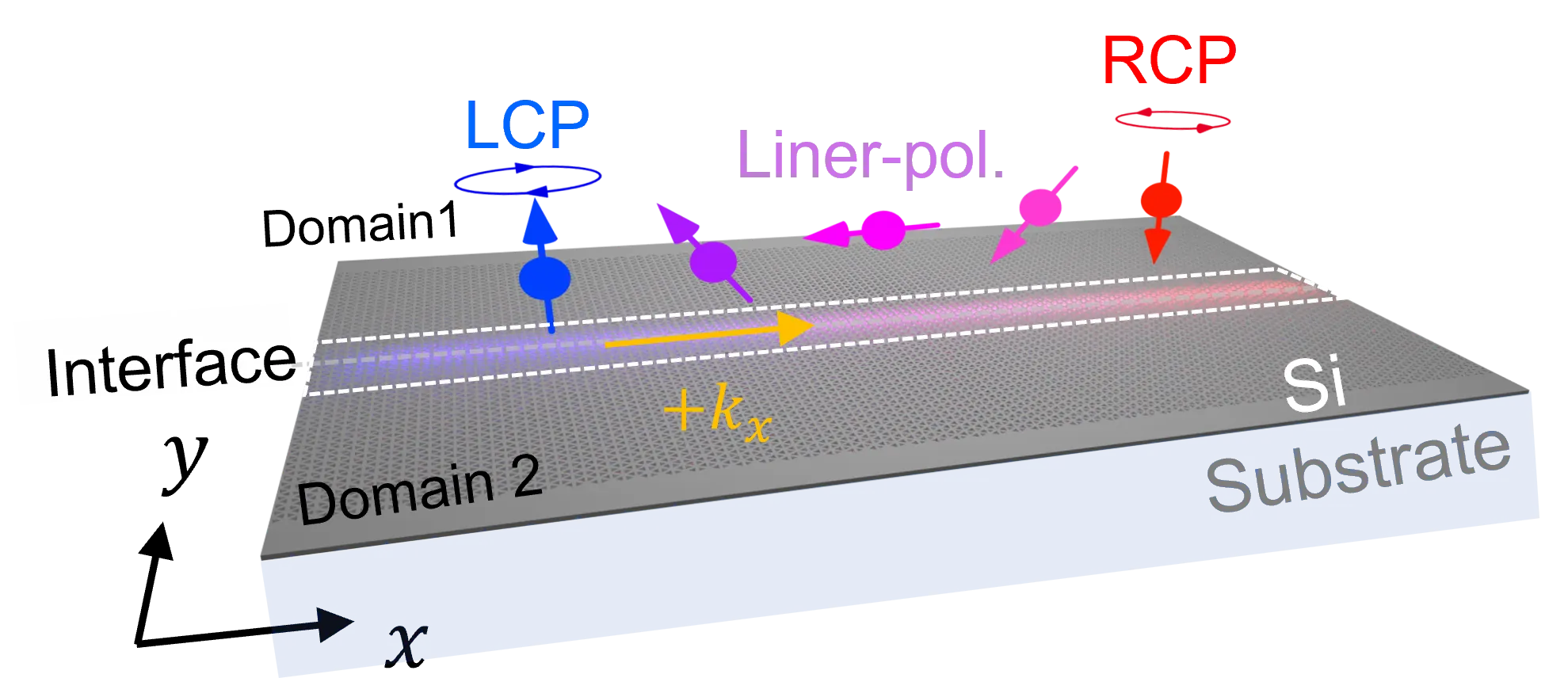
Pseudo-spin switches and Aharonov-Bohm effect for topological boundary modes
Science Advances 10(15), eadn60952024
- DOI
Abstract
Topological boundary modes in electronic and classical-wave systems exhibit fascinating properties. In photonics, topological nature of boundary modes can make them robust and endows them with an additional internal structure—pseudo-spins. Here, we introduce heterogeneous boundary modes, which are based on mixing two of the most widely used topological photonics platforms—the pseudo-spin–Hall-like and valley-Hall photonic topological insulators. We predict and confirm experimentally that transformation between the two, realized by altering the lattice geometry, enables a continuum of boundary states carrying both pseudo-spin and valley degrees of freedom (DoFs). When applied adiabatically, this leads to conversion between pseudo-spin and valley polarization. We show that such evolution gives rise to a geometrical phase associated with the synthetic gauge fields, which is confirmed via an Aharonov-Bohm type experiment on a silicon chip. Our results unveil a versatile approach to manipulating properties of topological photonic states and envision topological photonics as a powerful platform for devices based on synthetic DoFs.
Ring Resonators Integrating With Dichroic Materials and in Spin-Valley Controlled Photonic Topological System
Ph.D. dissertation, The City College of New York, CUNY2024Thesis
2023
Topological polaritonic structures based on patterned bulk transition metal dichalcogenide WS2 crystals
Active Photonic Platforms (APP) 2023, Proc. SPIE, 842023Conference paper
Spin-dependent properties of optical modes guided by adiabatic trapping potentials in photonic Dirac metasurfaces
Nature Nanotechnology 18(8), 875-8812023
Robust Si/Ge heterostructure metasurfaces as building blocks for wavelength-selective photodetectors
Applied Physics Letters 122(12), 1217012023
- DOI
Abstract
We present a design for silicon-compatible vertical Germanium pin photodiodes structured into all-dielectric metasurfaces. Proof-of-principle metasurfaces are fabricated on silicon-on-insulator wafers in a top-down process. Simulations and measurements of the spectroscopic properties, specifically the absorption, show high spectral selectivity, and absorption efficiencies as large as those in bulk Germanium layers with about four times the Ge layer thicknesses. Our metasurface structures can be tuned to the target wavelength through tailoring of the lateral geometry. Possible applications include spectroscopy and hyperspectral imaging, with several metasurfaces for different wavelength ranges integrated with readout circuitry into a low-cost electronic–photonic integrated circuit.
2022
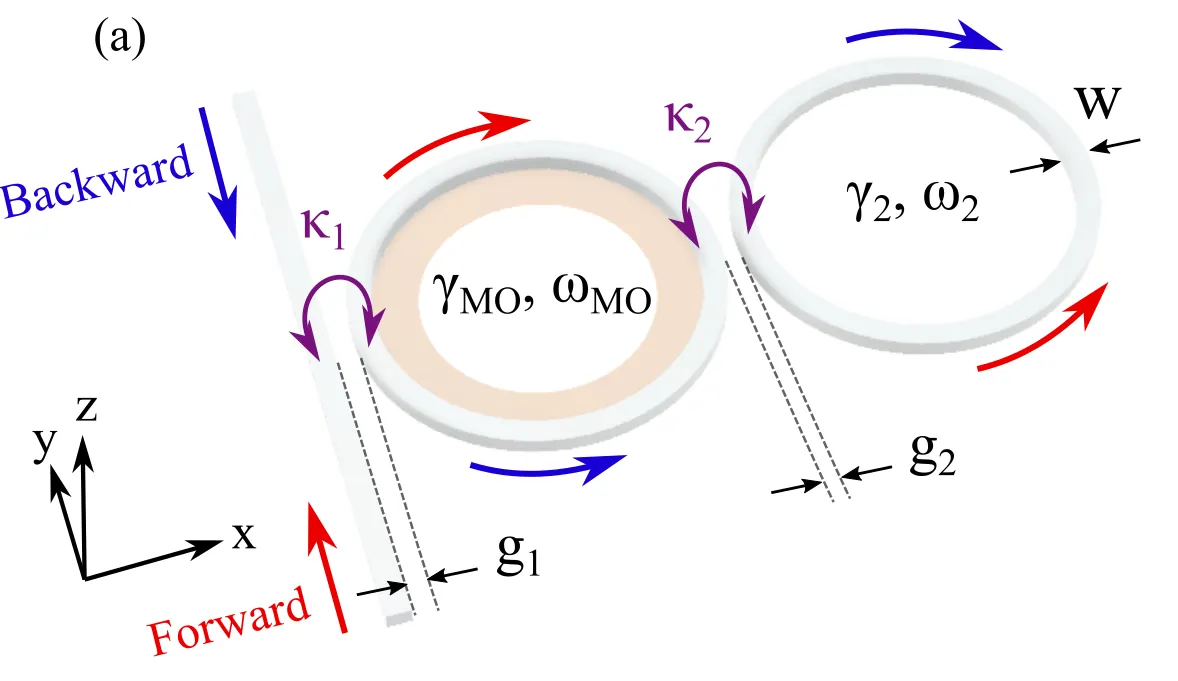
Non-reciprocal parity-time symmetry breaking based on magneto-optical and gain/loss double ring resonators
Optical Materials Express 12(4), 14532022
- DOI
Abstract
In this paper, we explore the operation of a nonreciprocal non-Hermitian system consisting of a lossy magneto-optical ring resonator coupled to another ring resonator with gain and loss, and we demonstrate that such a system can exhibit non-reciprocity-based broken parity-time (PT) symmetry and supports one-way exceptional points. The nonreciprocal PT-phase transition is analyzed with the use of both analytical tools based on coupled-mode theory and two-dimensional finite element method simulations. Our calculations show that the response of the system strongly depends on the regime of operation – broken or preserved PT-symmetry. This response is leveraged to show that the system can operate as an optical isolator or a one-way laser with functionality tuned by adjusting loss/gain in the second ring resonator. The proposed system can thus be promising for device applications such as magnetically or even optically switchable non-reciprocal devices and one-way micro-ring lasers.
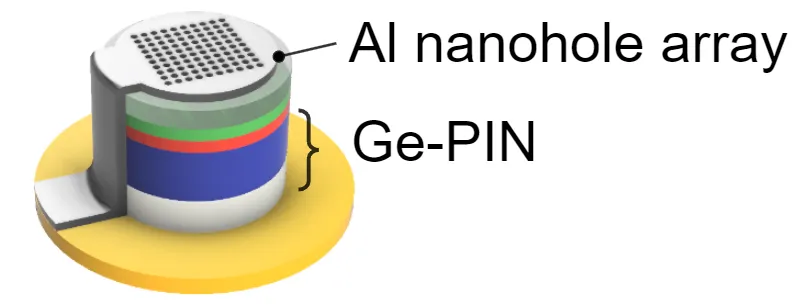
Optimization of Fully Integrated Al Nanohole Array-Based Refractive Index Sensors for Use With a LED Light Source
IEEE Photonics Journal 14(3), 1-82022
2021
Plasmonic gratings from highly doped Ge1−y Sn y films on Si
Journal of Physics D: Applied Physics 54(44), 4451092021
- DOI
Abstract
Plasmonic modes in metal structures are of great interest for optical applications. While metals such as Au and Ag are highly suitable for such applications at visible wavelengths, their high Drude losses limit their usefulness at mid-infrared wavelengths. Highly n-doped Ge1−y Sn y alloys are interesting possible alternative materials for plasmonic applications in this wavelength range. Here, we investigate the use of highly n-doped Ge1−y Sn y films grown directly on Si by molecular beam epitaxy with varying Sn-content from 0% up to 7.6% for plasmonic grating structures. We compare plasma wavelengths and relaxation times obtained from electrical and optical characterization. While theoretical considerations indicate that the decreasing effective mass with increasing Sn content in Ge1−y Sn y films could improve performance for plasmonic applications, our optical characterization results show that the utilization of Ge1−y Sn y films grown directly on Si is only beneficial if material quality can be improved.
All-optical nonreciprocity due to valley polarization pumping in transition metal dichalcogenides
Nature Communications 12(1), 37462021
- DOI
Abstract
Nonreciprocity and nonreciprocal optical devices play a vital role in modern photonic technologies by enforcing one-way propagation of light. Here, we demonstrate an all-optical approach to nonreciprocity based on valley-selective response in transition metal dichalcogenides (TMDs). This approach overcomes the limitations of magnetic materials and it does not require an external magnetic field. We provide experimental evidence of photoinduced nonreciprocity in a monolayer WS2 pumped by circularly polarized (CP) light. Nonreciprocity stems from valley-selective exciton population, giving rise to nonlinear circular dichroism controlled by CP pump fields. Our experimental results reveal a significant effect even at room temperature, despite considerable intervalley-scattering, showing promising potential for practical applications in magnetic-free nonreciprocal platforms. As an example, here we propose a device scheme to realize an optical isolator based on a pass-through silicon nitride (SiN) ring resonator integrating the optically biased TMD monolayer.
Optical isolator based on chiral light-matter interactions in a ring resonator integrating a dichroic magneto-optical material
Applied Physics Letters 118(24), 2411042021
- DOI
Abstract
Nonreciprocal optical devices based on magneto-optical ferrites in their low-loss regimes have been widely investigated as a promising platform for integrated photonics. Nonreciprocity in such devices originates from circular birefringence, leading to frequency splitting of forward and backward modes and, as a result, nonreciprocal transmission. In this paper, we propose an alternative approach to realize nonreciprocal devices based on magneto-optical circular dichroism and relying on the very presence of optical absorption. Our approach relies on the phenomenon of spin-Hall effect of light, which gives rise to chiral near field interactions of light carrying transverse angular momentum with matter, which, in lossy regimes, yields a disparate absorption for forward and backward optical modes. As an example of practical application, we design an optical isolator based on ring resonator integrating Ce:YIG ferrite, and we demonstrate isolation near 880 nm absorption line due to the ionic electric dipole transition. A Ce:YIG film asymmetrically placed on the inner side of the ring yields different critical coupling conditions due to the chiral nature of evanescent light for forward and backward waves, leading to nonreciprocal absorption and transmission. The proposed approach to nonreciprocity may significantly broaden the possible choice of magneto-optical materials for nonreciprocal devices, enabling operation even in lossy regimes.
2020
All-optical nonreciprocity due to valley polarization in transition metal dichalcogenides
arXiv preprint2020Preprint
- arXiv
Abstract
Nonreciprocity and nonreciprocal optical devices play a vital role in modern photonic technologies by enforcing one-way propagation of light. Most nonreciprocal devices today are made from a special class of low-loss ferrites that exhibit a magneto-optical response in the presence of an external static magnetic field. While breaking transmission symmetry, ferrites fail to satisfy the need for miniaturization of photonic circuitry due to weak character of nonreciprocal responses at optical wavelengths and are not easy to integrate into on-chip photonic systems. These challenges led to the emergence of magnetic-free approaches relying on breaking time reversal symmetry, e.g. with nonlinear effects modulating optical system in time. Here, we demonstrate an all-optical approach to nonreciprocity based on nonlinear valley-selective response in transition metal dichalcogenides (TMDs). This approach overcomes the limitations of magnetic materials and it does not require an external magnetic field. We provide experimental evidence of photoinduced nonreciprocity in a monolayer WS2 pumped by circularly polarized light. Nonreciprocity stems from valley-selective exciton-exciton interactions, giving rise to nonlinear circular dichroism controlled by circularly polarized pump fields. Our experimental results reveal a significant effect even at room temperature, despite considerable intervalley-scattering, showing potential for practical applications in magnetic-free nonreciprocal platforms. As an example, we propose a device scheme to realize an optical isolator based on a pass-through silicon nitride (SiN) ring resonator integrating the optically biased TMD monolayer.
2018
Integrated Collinear Refractive Index Sensor with Ge PIN Photodiodes
ACS Photonics 5(11), 4586-45932018
Simulation-based optimization of Ge-PIN-photodiodes with Al nanohole arrays for refractive index sensing
2018 41st International Convention on Information and Communication Technology, Electronics and Microelectronics (MIPRO), 23–262018Conference paper
No publications match these filters.