Journal article · 2022
Non-reciprocal parity-time symmetry breaking based on magneto-optical and gain/loss double ring resonators
Abstract
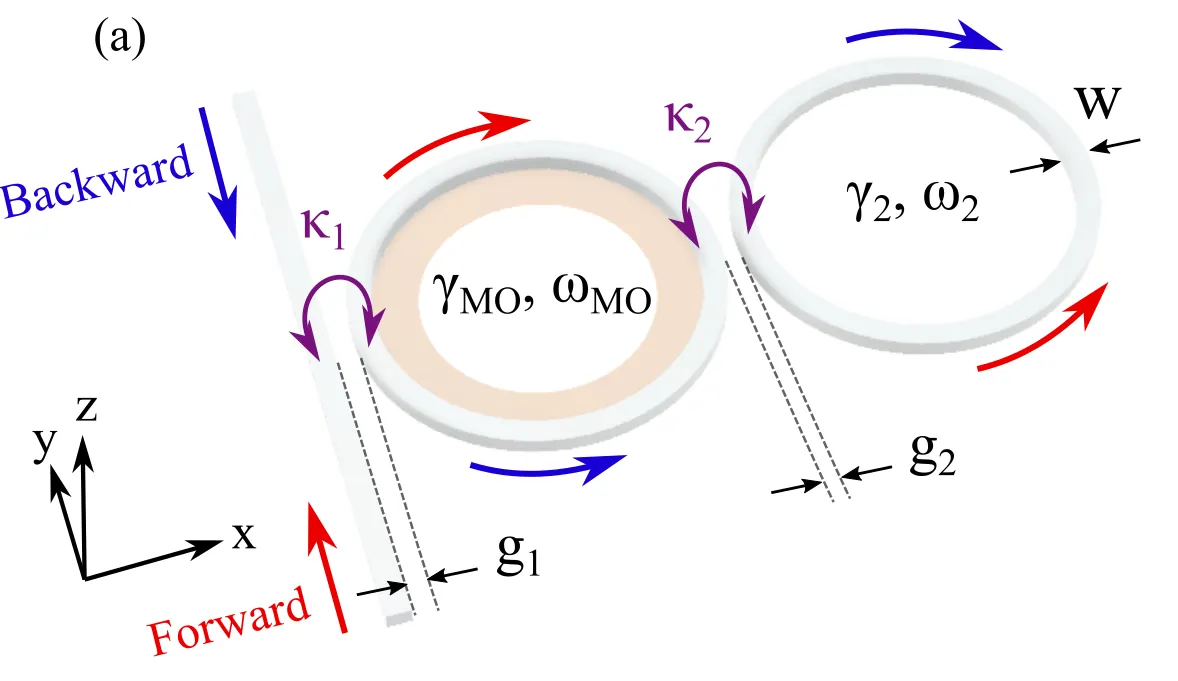
In this paper, we explore the operation of a nonreciprocal non-Hermitian system consisting of a lossy magneto-optical ring resonator coupled to another ring resonator with gain and loss, and we demonstrate that such a system can exhibit non-reciprocity-based broken parity-time (PT) symmetry and supports one-way exceptional points. The nonreciprocal PT-phase transition is analyzed with the use of both analytical tools based on coupled-mode theory and two-dimensional finite element method simulations. Our calculations show that the response of the system strongly depends on the regime of operation – broken or preserved PT-symmetry. This response is leveraged to show that the system can operate as an optical isolator or a one-way laser with functionality tuned by adjusting loss/gain in the second ring resonator. The proposed system can thus be promising for device applications such as magnetically or even optically switchable non-reciprocal devices and one-way micro-ring lasers.
Topics
Cite
@article{kawaguchi2022nonreciprocal,
  title = {{Non-reciprocal parity-time symmetry breaking based on magneto-optical and gain/loss double ring resonators}},
  author = {Yuma Kawaguchi and Andrea Alù and Alexander B. Khanikaev},
  journal = {Optical Materials Express},
  volume = {12},
  number = {4},
  pages = {1453},
  year = {2022},
  doi = {10.1364/ome.450821}
}